By: Chris LaVoie
There’s a secret handshake among Oregon cyclists, and it doesn’t involve spandex or carbon fiber. It involves a calendar, a snowplow schedule, and a very specific stretch of pavement known as Highway 242.
If you’ve ever driven the McKenzie Pass, you know it’s a tight, twisty, “white-knuckle” kind of road that makes even the most confident SUV driver sweat. But for a few glorious weeks every spring, the engines stay silent, the gates remain locked to cars, and the road becomes a paved playground for those of us on two wheels.
We call it “The Magic Window,” and if you haven’t experienced it yet, grab your helmet. We’re going for a ride.
The Clock is Ticking: Why June 15th Matters
Every year, the Oregon Department of Transportation (ODOT) plays a high-stakes game of “Whack-a-Mole” with snowdrifts on the McKenzie Pass. They start plowing as soon as the weather breaks, but the road doesn’t officially open to cars until the third Monday in June. For 2026, that big day is June 15th.
Until those gates swing wide for the summer tourists and their motorhomes, the pass is: unofficially: the best bike path in the world. You get roughly 38 miles of pristine, winding asphalt all to yourself. No exhaust, no side-mirror scares, and definitely no “hurry up and wait” behind a slow-moving trailer. Just you, the wind, and the sound of your own heavy breathing. (And trust me, there will be heavy breathing.)
The 2,000-Foot Elevator Ride
Let’s be real: this isn’t a casual cruise to the grocery store. Whether you start from the west side near Belknap or the east side in Sisters, you’re looking at a serious climb. From the west, you’re tackling over 2,000 feet of vertical gain.
It starts in the deep, lush canopy of the Willamette National Forest. You’ll pedal past towering Douglas firs and smell that “only-in-Oregon” scent of damp moss and pine. But as you climb, the world begins to change. The trees start to thin, the air gets a little crispier, and suddenly, you break out of the forest and into what looks like the surface of the moon.
The reward for all that sweat? The lava fields.
Lava, Lava Everywhere (And a Very Cool Tower)
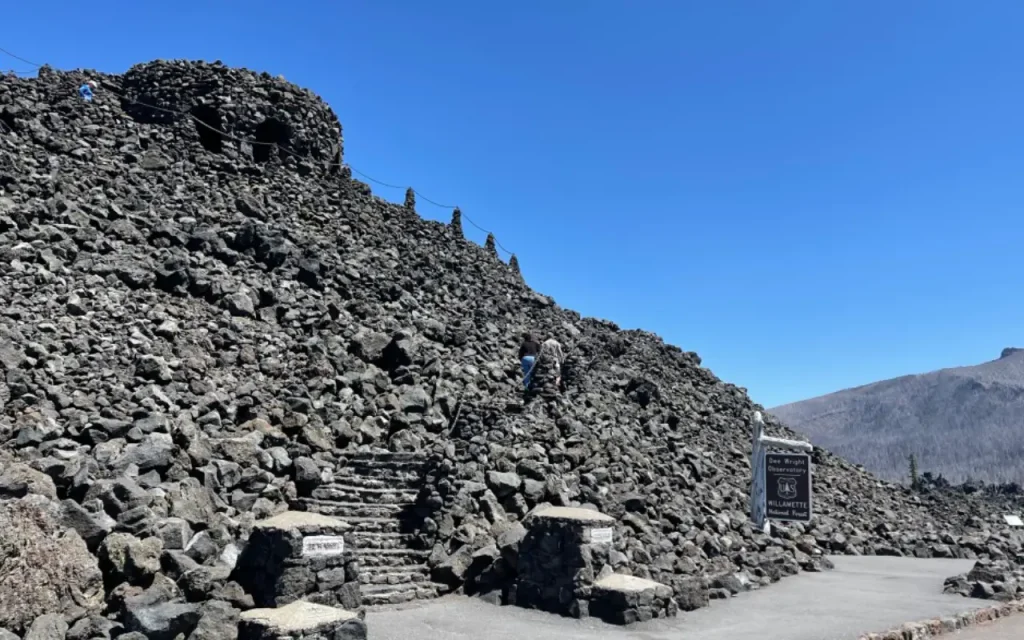
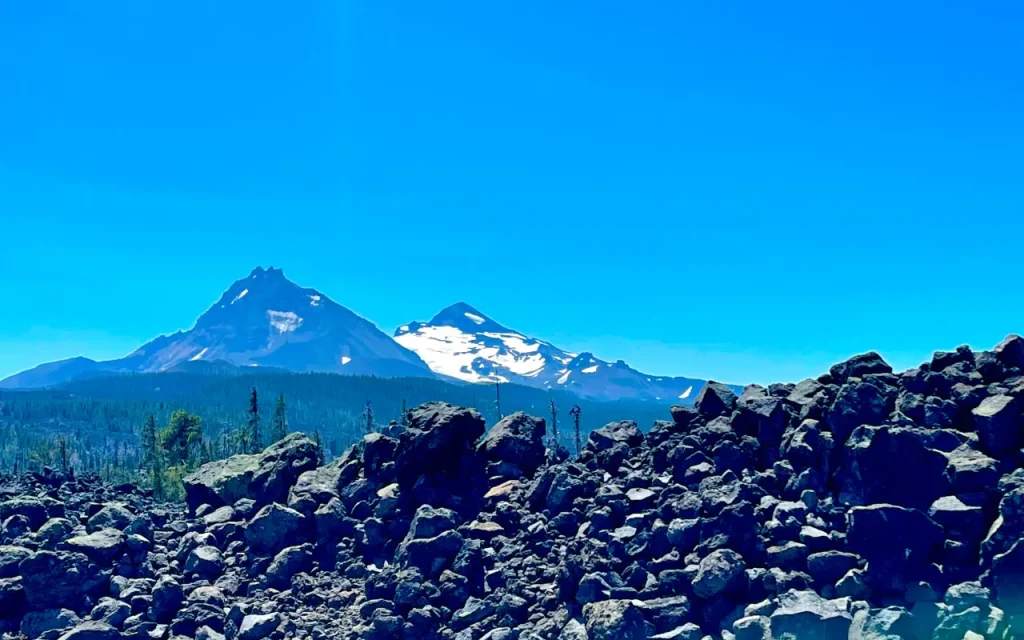
Reaching the summit of McKenzie Pass is like winning a prize you didn’t know you were competing for. You’ll find yourself surrounded by 65 square miles of jagged, black basalt: the remnants of volcanic eruptions from about 2,000 years ago. It’s raw, it’s dramatic, and it’s unlike anything else in the state.
Perched right in the middle of this volcanic wasteland is the Dee Wright Observatory. Built by the Civilian Conservation Corps in the 1930s out of: you guessed it: lava rock, it looks like something out of a medieval fantasy novel. Head inside, and you’ll find small viewing windows that act like “telescopes” without the glass, perfectly framing the surrounding peaks: North and Middle Sister, Mt. Washington, and Mt. Jefferson.
Standing there with your bike, looking out over the lava to the snow-capped peaks, you’ll realize why we wait all year for this. It’s pure, unadulterated outdoor adventure.
The “Closed” Reality Check
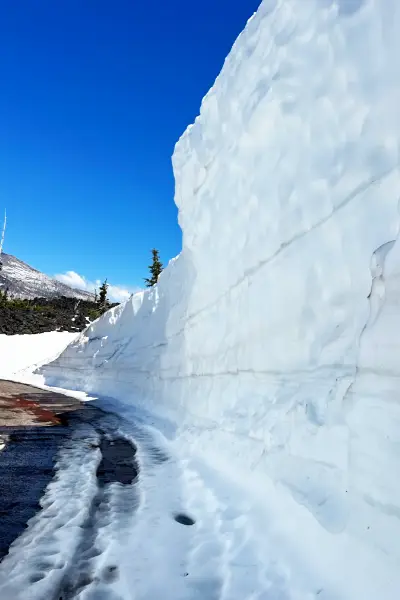
Before you go full “Tour de France” on us, we need to have a quick heart-to-heart about safety. Even though the gates are closed to cars, the road isn’t technically a public park. ODOT is hard at work during this window.When you see a sign that says “Closed,” ODOT means it. They’re up there with heavy machinery, snowplows, and crews clearing “hazard trees” (trees that decided they’d rather be horizontal during the winter). McKenzie River Mountain Resort, a local McKenzie Pass shuttle operator, puts it simply: “We recommend going on the weekend when the ODOT crews aren’t working.”
That said, ODOT typically doesn’t provide public work schedules, so there’s always a little mystery baked into the adventure. Know that if you do roll up on a crew, you may be forced to turn back or, if they’re feeling generous, walk your bike along the shoulder through the work zone. Riding through an active work area is a big no-no, and yes, it can actually result in a citation. So check the local laws, use good judgment, and be extra respectful of the men and women doing the heavy lifting to get the pass ready for summer.
Also, watch out for “re-freeze.” Even if it’s 70 degrees in Eugene, there can be black ice in the shadows of the lava rocks at the summit. Nobody wants their epic ride to end with a slide across volcanic sandpaper.
Choose Your Adventure: 4 Ways to Ride the Pass
One of the best things about cycling McKenzie Pass is that you can make the day as mellow or as spicy as you want. Here are four classic ways to do it, depending on how much suffering you enjoy before the snacks come out.
1. Sisters to Dee Wright: The “Easy” Button
This is the shortest and easiest route of the bunch, which makes it a great pick if you want the big summit payoff without turning the day into a full-blown survival story. You’ll still get the lava fields, the observatory, and those huge Cascade views, but you’ll miss out on the jaw-dropping beauty of the west side. Think of it as the sampler platter: still excellent, just not the whole feast.
2. McKenzie Bridge to Dee Wright and Back: The “Leg Burner”
This one is for the riders who hear “2,000 feet of climbing” and say, “Cool, what else ya got?” Starting in McKenzie Bridge and heading up to Dee Wright before turning around is perfect for hardcore cyclists who want to earn every single view. You get the full transition from lush forest to wild lava, and then you get to do the whole thing in reverse with tired legs and a giant grin.
3. McKenzie Bridge to Sisters: The “Pure Grunt”
This is the route for climbers who apparently don’t believe in rewarding themselves with a nice, long downhill run. You’ll put in the work from the west side, crest the pass, and keep rolling east to Sisters. It’s a beautiful, brag-worthy ride and a solid choice if you’re setting up a shuttle or point-to-point adventure. Just know this one is less “lazy river float” and more “I paid for all my gears, so I’m using all my gears.”
4. Sisters to McKenzie Bridge (The Crowd Favorite)
If you ask around, this is the one people rave about most. You get a totally doable climb out of Sisters, then after soaking in the summit views, you roll into that dreamy downhill glide through the lush, green west-side forest. It’s scenic, satisfying, and just plain fun. Better yet, you can stop at Proxy Falls along the way for one of the prettiest side quests in Oregon. Just don’t forget to bring a lock for your bike if you plan to hike.
🗺️ The Quick Stats: Pick Your Perfect Route
If your group chat is currently full of “Wait, which route are we doing?” texts, here’s the fast-and-glorious cheat sheet. Think of this as your trailhead whiteboard, minus the bad handwriting.
| Route Option | Distance | Elevation Gain | Avg. Ride Time | Difficulty Scale |
|---|---|---|---|---|
| 1. Sisters to Dee Wright | ~15 Miles (One Way) | +2,100 ft | 1.5 – 2 Hours | 🟢🟢⚪⚪⚪ (Moderate) |
| 2. McKenzie Bridge to Dee Wright & Back | ~44 Miles (Round Trip) | +3,900 ft | 3.5 – 5 Hours | 🔴🔴🔴🔴🔴 (Hardcore) |
| 3. McKenzie Bridge to Sisters | ~38 Miles (Point-to-Point) | +3,900 ft | 3.5 – 4.5 Hours | 🔴🔴🔴🔴⚪ (Pure Grunt) |
| 4. Sisters to McKenzie Bridge | ~38 Miles (Point-to-Point) | +2,100 ft | 2.5 – 4 Hours | 🔵🔵🔵🔵⚪ (Crowd Favorite) |
Want the nitty-gritty details? Check out the full route guides on McKenzieRiverTrail.com.
Pro Tips for Your Pass Attempt
If you’re ready to tackle the “Magic Window,” here’s how to do it right:
- Water is Your Best Friend: There are no fountains in the lava fields. Pack more than you think you need.
- Layers, Layers, Layers: You’ll be sweating on the way up, but the descent is fast and chilly. A windbreaker or a light vest is a lifesaver.
- Start Early: The wind can pick up in the afternoon, and you want to be heading down before the sun starts to dip behind the peaks.
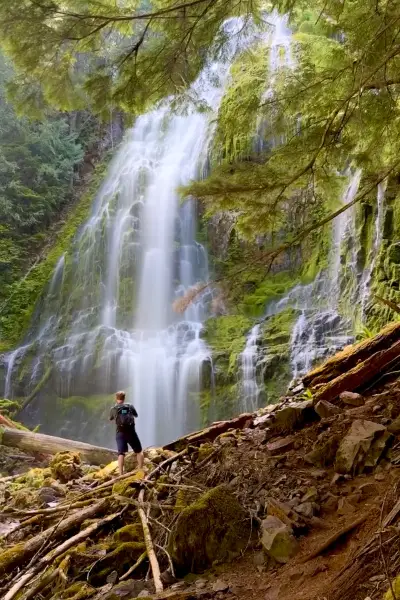
- Take the Detour: If you have any gas left in the tank on your way back down the west side, stop by Proxy Falls. It’s one of the most photographed waterfalls in Oregon for a reason, and it’s just a short hike off the road.
Where to Base Your Mission
If you’re coming from out of town (or just want to make a weekend of it), I highly recommend starting from the west side. You can grab a pre-ride coffee (or a post-ride burger) at one of our local restaurants, or even stay the night near the river so you can hit the road as soon as the sun comes up.
The McKenzie Pass car-free window is one of those “bucket list” experiences that reminds you why we live in this corner of the world. It’s challenging, it’s beautiful, and it’s fleeting.
So, mark your calendar for early June. Check the snow reports. Pump up those tires. The lava is waiting, the observatory is standing tall, and the engines won’t start roaring until the 15th. We’ll see you at the top!
By: Chris LaVoie